Wednesday, March 18, 2020


Biological Significance of Mitosis & Meiosis in Sexual Reproduction
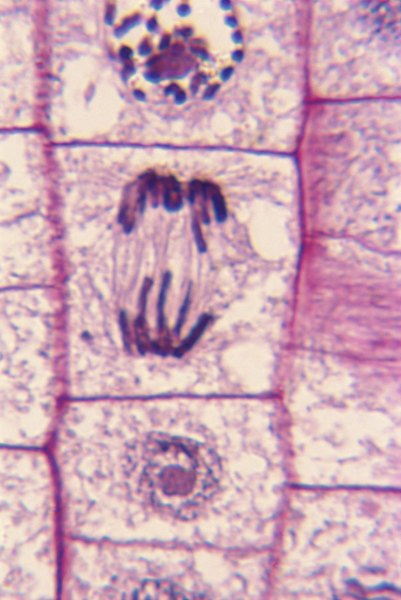


Before a cell divides, the chromosomes, which carry genetic information, migrate to opposite ends of the cell.
Mitosis and meiosis both involve cells dividing to make new cells. This makes them both vital processes for the existence of living things that reproduce sexually. Meiosis makes the cells needed for sexual reproduction to occur, and mitosis replicates non-sex cells needed for growth and development. Together, they provide the cellular basis for healthy growth and sexual reproduction.


  Overview of meiosis

Meiosis is the process by which sexually reproducing organisms make their sex cells, sperm and eggs. During meiosis, a specialized cell called a germ cell splits to make four new sex cells, each with half the number of chromosomes as the original germ cell. Each of the four sex cells has a unique combination of DNA, meaning no two sperm or eggs are genetically identical.

Significance of Meiosis and Chromosome Number

Chromosomes are the cell's way of neatly arranging long strands of DNA. Non-sex cells have two sets of chromosomes, one set from each parent. Meiosis makes sex cells with only one set of chromosomes. For example, human cells have 46 chromosomes, with the exception of sperm and eggs, which contain only 23 chromosomes each. When a sperm cell fertilizes an egg, the 23 chromosomes from each sex cell combine to make a zygote, a new cell with 46 chromosomes. The zygote is the first cell in a new individual.

Significance of Meiosis for Diversity

One of the benefits of sexual reproduction is the diversity it produces within a population. That variety is a direct product of meiosis. Every sex cell made from meiosis has a unique combination of chromosomes. This means that no two sperm or egg cells are genetically identical. Every fertilization event produces new combinations of traits. This is why siblings share DNA with parents and each other, but are not identical to one another.

Overview of mitosis

Mitosis is the process by which non-sex cells divide to make new cells. After a fertilization event, mitosis kicks in to begin making copies of the newly formed zygote. The first cell will duplicate itself through mitosis. The two resulting cells will also be duplicated. And the process will continue exponentially throughout the organism's lifetime. This is how individuals grow body parts, develop, repair damaged tissues, replace dead cells and change at a cellular level as they mature. Mitosis always produces two cells that are genetically identical to each other and the original cell.

Significance of mitosis for sexual reproduction

Mitosis is important for sexual reproduction indirectly. It allows the sexually reproducing organism to grow and develop from a single cell into a sexually mature individual. This allows organisms to continue to reproduce through the generations.


Thursday, February 27, 2020

Stages of cell division


Stages of the cell cycle

To divide, a cell must complete several important tasks: it must grow, copy its genetic material (DNA), and physically split into two daughter cells. Cells perform these tasks in an organized, predictable series of steps that make up the cell cycle. The cell cycle is a cycle, rather than a linear pathway, because at the end of each go-round, the two daughter cells can start the exact same process over again from the beginning.
In eukaryotic cells, or cells with a nucleus, the stages of the cell cycle are divided into two major phases: interphase and the mitotic (M) phase.
  • During interphase, the cell grows and makes a copy of its DNA.
  • During the mitotic (M) phase, the cell separates its DNA into two sets and divides its cytoplasm, forming two new cells.

Interphase

Let’s enter the cell cycle just as a cell forms, by division of its mother cell. What must this newborn cell do next if it wants to go on and divide itself? Preparation for division happens in three steps:
  • Gstart subscript, 1, end subscript phase. During Gstart subscript, 1, end subscript phase, also called the first gap phase, the cell grows physically larger, copies organelles, and makes the molecular building blocks it will need in later steps.
  • S phase. In S phase, the cell synthesizes a complete copy of the DNA in its nucleus. It also duplicates a microtubule-organizing structure called the centrosome. The centrosomes help separate DNA during M phase.
  • M phase

    During the mitotic (M) phase, the cell divides its copied DNA and cytoplasm to make two new cells. M phase involves two distinct division-related processes: mitosis and cytokinesis.
    In mitosis, the nuclear DNA of the cell condenses into visible chromosomes and is pulled apart by the mitotic spindle, a specialized structure made out of microtubules. Mitosis takes place in four stages: prophase (sometimes divided into early prophase and prometaphase), metaphase, anaphase, and telophase. You can learn more about these stages in the video on mitosis
    In cytokinesis the cytoplasm of the cell is split in two, making two new cells. Cytokinesis usually begins just as mitosis is ending, with a little overlap. Importantly, cytokinesis takes place differently in animal and plant cells.

    M phase

    During the mitotic (M) phase, the cell divides its copied DNA and cytoplasm to make two new cells. M phase involves two distinct division-related processes: mitosis and cytokinesis.
    In mitosis, the nuclear DNA of the cell condenses into visible chromosomes and is pulled apart by the mitotic spindle, a specialized structure made out of microtubules. Mitosis takes place in four stages: prophase (sometimes divided into early prophase and prometaphase), metaphase, anaphase, and telophase. You can learn more about these stages in the video on mitosis. 

Friday, January 31, 2020

Introduction to cell cycle

Introduction :-
Cell division is the process by which a parent cell divides into two or more daughter cells.Cell division usually occurs as part of a larger cell cycle. In eukaryotes, there are two distinct types of cell division: a vegetative division, whereby each daughter cell is genetically identical to the parent cell (mitosis), and a reproductive cell division, whereby the number of chromosomes in the daughter cells is reduced by half to produce haploid gametes(meiosis).Meiosis results in four haploid daughter cells by undergoing one round of DNA replication followed by two divisions. Homologous chromosomes are separated in the first division, and sister chromatids are separated in the second division. Both of these cell division cycles are used in the process of sexual reproduction at some point in their life cycle. Both are believed to be present in the last eukaryotic common ancestor.
Prokaryotes (bacteria) undergo a vegetative cell division known as binary fission, where their genetic material is segregated equally into two daughter cells. While binary fission may be the means of division by most prokaryotes, there are alternative manners of division, such as budding, that have been observed. All cell divisions, regardless of organism, are preceded by a single round of DNA replication.
For simple unicellular microorganisms such as the amoeba, one cell division is equivalent to reproduction – an entire new organism is created. On a larger scale, mitotic cell division can create progeny from multicellular organisms, such as plants that grow from cuttings. Mitotic cell division enables sexually reproducing organisms to develop from the one-celled zygote, which itself was produced by meiotic cell division from gametes. After growth, cell division by mitosis allows for continual construction and repair of the organism. The human body experiences about 10 quadrillion cell divisions in a lifetime.